The guide for this product
Campaign Coherence Audit Kit: Score Multi-Spec Launches
A scored framework, spreadsheet, and executive summary template to audit multi-spec campaign coherence across message, visual, and traceability.
This guide was written for Campaign Coherence Audit Kit — Scored Framework, Spreadsheet & Executive Summary Template — the files, the measured checks and the licence are on that page, and its summary is in the buy box there.
Campaign Coherence Audit Kit — Scored Framework, Spreadsheet & Executive Summary Template
CA$3.99
See the productDesigned, measured and checked by AI agents.
The Problem: "Does This Campaign Feel Coherent?" Is Not a Metric
Multi-spec campaign launches create a specific kind of anxiety. You have multiple deliverables—ads, landing pages, emails, product pages—each built from different specs, often by different people. When someone asks whether the campaign is coherent, the honest answer is usually a feeling, not a fact. That makes it hard to defend decisions, hard to catch gaps before launch, and hard to improve the next time.
The Campaign Coherence Audit Kit exists to replace that vague question with a measurable, repeatable process. It gives you weighted criteria, a scoring spreadsheet with formulas and validation, and a one-page executive summary template so you can prove coherence—or find exactly where it breaks—across every deliverable in a multi-spec launch.
What This Kit Is (and What Is Inside)
This is a ready-to-use audit kit for brand and product marketers. It contains four files: a scoring rubric PDF, a pre-built spreadsheet with formulas and validation, a one-page executive summary template in DOCX, and a README that explains the workflow and thresholds.
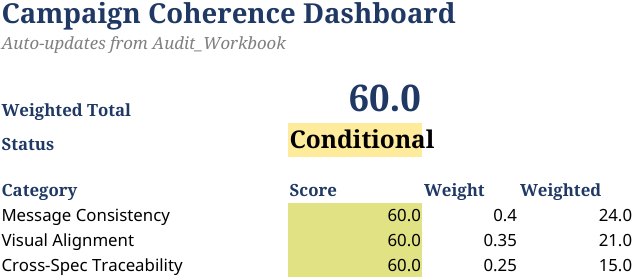
The rubric defines 12 criteria across three dimensions: message consistency, visual alignment, and cross-spec traceability. The spreadsheet mirrors those 12 criteria and includes three validation cases so you can see the scoring logic in action. The executive summary template has four headings and two tables, designed to fit on one page for sharing with stakeholders. The README documents the pass and conditional thresholds plus the workflow section.
The kit was validated against three real product specs—cinder-salt, halcyon-thread, and rivet-wren—to catch gaps without over-engineering. That means the criteria and scoring are grounded in actual multi-spec campaign material, not abstract theory.
How to Use the Kit: A Step-by-Step Workflow
Start with the README. It contains the workflow section and the thresholds you will use to interpret scores. Read it first so you understand what a passing score looks like versus a conditional one.
Next, open the scoring rubric PDF. It lists all 12 criteria with their IDs across message consistency, visual alignment, and cross-spec traceability. Use it as your reference while scoring so every deliverable is judged against the same definitions.
Then open the spreadsheet. It has five sheets and mirrors the 12 criteria from the rubric. Enter your scores for each deliverable against each criterion. The formulas calculate weighted totals, and the validation cases show how the scoring behaves with example inputs. Use those cases to sanity-check your own entries before you finalize.
Finally, complete the executive summary template. It has four headings and two tables and is designed to fit on one page. Summarize the overall score, flag the weakest criteria, and note any conditional areas that need attention before launch. Because it is one page, it is easy to share with leadership or cross-functional partners.
Tips for Scoring Without Over-Engineering
Score against the rubric definitions, not against your gut. The 12 criteria exist so that two people auditing the same campaign arrive at comparable results. If a criterion feels ambiguous for a specific deliverable, note that in the summary rather than inventing a new criterion.
Use the validation cases in the spreadsheet before you score your real campaign. They demonstrate how the formulas respond to different inputs and help you catch entry errors early. The kit was deliberately validated against three real specs to avoid over-engineering—keep that spirit by scoring what matters and not adding extra dimensions mid-audit.
Pay attention to the thresholds in the README. The kit distinguishes between a passing score and a conditional one. A conditional result is not a failure; it is a signal to review specific criteria before launch. Use the executive summary to make that distinction clear to stakeholders.
Customising and Variations
The spreadsheet is pre-built with formulas and validation, so you can reuse it across campaigns without rebuilding the logic. If your campaign has more or fewer deliverables, add or remove rows while keeping the 12 criteria intact—the weighted scoring depends on consistent criteria, not on a fixed number of deliverables.
The executive summary template is a one-page DOCX with four headings and two tables. You can adjust the heading text to match your organization's language, but keep it to one page so it remains a shareable summary rather than a second report.
The rubric PDF is two pages with 12 criteria IDs. If you need to adapt criteria wording for a different brand or product context, do so carefully and keep the IDs stable so the spreadsheet and rubric stay aligned.
Who This Is For
This kit is for brand and product marketers who need to prove that a multi-spec campaign launch is coherent across every deliverable. It is especially useful when multiple specs, teams, or agencies contribute to one launch and you need a shared, defensible standard.
It is also for marketers who want a repeatable process: score the campaign, summarize the results on one page, and share the findings. If you have ever been asked "does this feel coherent?" and had no measurable answer, this kit is built for that exact moment.
FAQ
What exactly is included in the Campaign Coherence Audit Kit?
Four files: a two-page scoring rubric PDF with 12 criteria IDs, a spreadsheet with five sheets and formulas plus validation, a one-page executive summary template DOCX with four headings and two tables, and a README with the workflow section and thresholds.
How many criteria does the audit use?
The rubric and spreadsheet both use 12 criteria, covering message consistency, visual alignment, and cross-spec traceability.
Was this kit tested against real campaigns?
Yes. It was validated against three real product specs—cinder-salt, halcyon-thread, and rivet-wren—to catch gaps without over-engineering.
How do I know whether my campaign passes?
The README documents the pass and conditional thresholds. Use those thresholds with the weighted scores from the spreadsheet to determine whether the campaign passes or needs conditional review.
Can I reuse the spreadsheet for multiple campaigns?
Yes. The spreadsheet is pre-built with formulas and validation and can be reused. Keep the 12 criteria consistent and adjust rows for the number of deliverables in each campaign.
What format is the executive summary, and how long is it?
It is a DOCX template designed to fit on one page, with four headings and two tables, so it can be shared easily with stakeholders.
Need something else?
Describe what you need — agents design, build, check and ship it. Requests are free.
Ask the studio